Archives

Blocking your Crochet Piece

I am always debating whether to block my finished crochet piece??  For me, it all depends upon the type of yarn I have used and what my completed project is — a doily or clothing or afghan.

It is very important to always read what the manufacturer of the yarn recommends when it comes to washing and/or dry cleaning suggestions.  If using a cotton yarn/thread, I like to hand wash my completed project and lay if flat to dry.  When it is almost dry but still slightly damp, I will place it onto my ironing board, cover it with a towel and then use the steam feature on my iron.  Holding the iron very close to the towel without actually placing the iron on the item.  This will give you a smooth finished look without stretching the yarn and eliminate any curling that might have occurred.

One concern with cotton yarn that I always seem to dwell upon is the question of shrinkage.  I haven’t experienced any problems with shrinkage as long as I use cold water and air dry.  Then block the piece as mentioned above.

When using a wool blend yarn, again follow the manufacturer’s washing/dry cleaning directions, and then, if needed, you can block the piece the same way as described above.   A lot of times, however, when I have completed a project,  I will lay it out flat on a padded surface, spray it lightly with water, and just pat it into shape and let air dry.

I find too that if I am crocheting a sweater, it is a little easier to block or shape your pieces as you crochet them.  Again, laying them out on a padded surface, spray lightly with water and just pat them into their shape and air dry.  Then everything is ready to be joined according to your pattern directions.

You will find there are those projects that really need to be a certain size when completed, i.e., socks, mittens, hats,  some sweaters, and blocking your piece helps you to shape your work to those measurements.   Most importantly, your crocheting GAUGE must be accurate too for the completed project to be the size you need.    Blocking tools are available that you can put your damp project over to assist you in this shaping process.

My daughter and I are presently experimenting with blocking a rather large afghan that seems to curl on the edges.  We are laying it out flat onto a carpeted area that we have laid several towels down first.  Then we will be spritzing it with water, covering it with more large towels and then running a floor steamer over the top of everything.  Again, not touching the project with the steamer itself, just shooting the steam through everything.  Then we will  take the top towels off, pat into shape and let air dry.   We feel confident that this will work and will be much easier to shape since the afghan is a comforter size.

Always trying to keep those “creative juices” flowing!!

HAPPY CREATING!!

Disclaimer:  This post contains affiliate links – “small commission earned”

Comfy Hold on your Crochet Hook

The way you hold your crochet hook is a very personal thing.  The most important thing to remember is not to grip it so hard that your hand muscles and fingers become exhausted.  To me, that takes the fun out of crocheting!!  Just a light but secure grip is all that is needed.

I guess first it is helpful to dissect a crochet hook.  You have the point, throat, shaft, thumb rest and handle.  The shaft and thumb rest is where your fingers will always be when crocheting.  The point and throat are where you actually make your stitches and the handle is basically there for balance.

Hook Description


My grandmother originally taught  me how to crochet but being the only left-handed person in my family, she could only teach me how to hold the hook like a right-handed crocheter.  Actually,  I have found that holding and working the crochet hook in my right hand and controlling the yarn with my left hand really is much easier for me because the hook movement is just a repetitive motion but keeping the tension and working with the yarn requires more control.  Using my left hand for the more intricate work (which is my stronger and more coordinated hand) works great for me!!

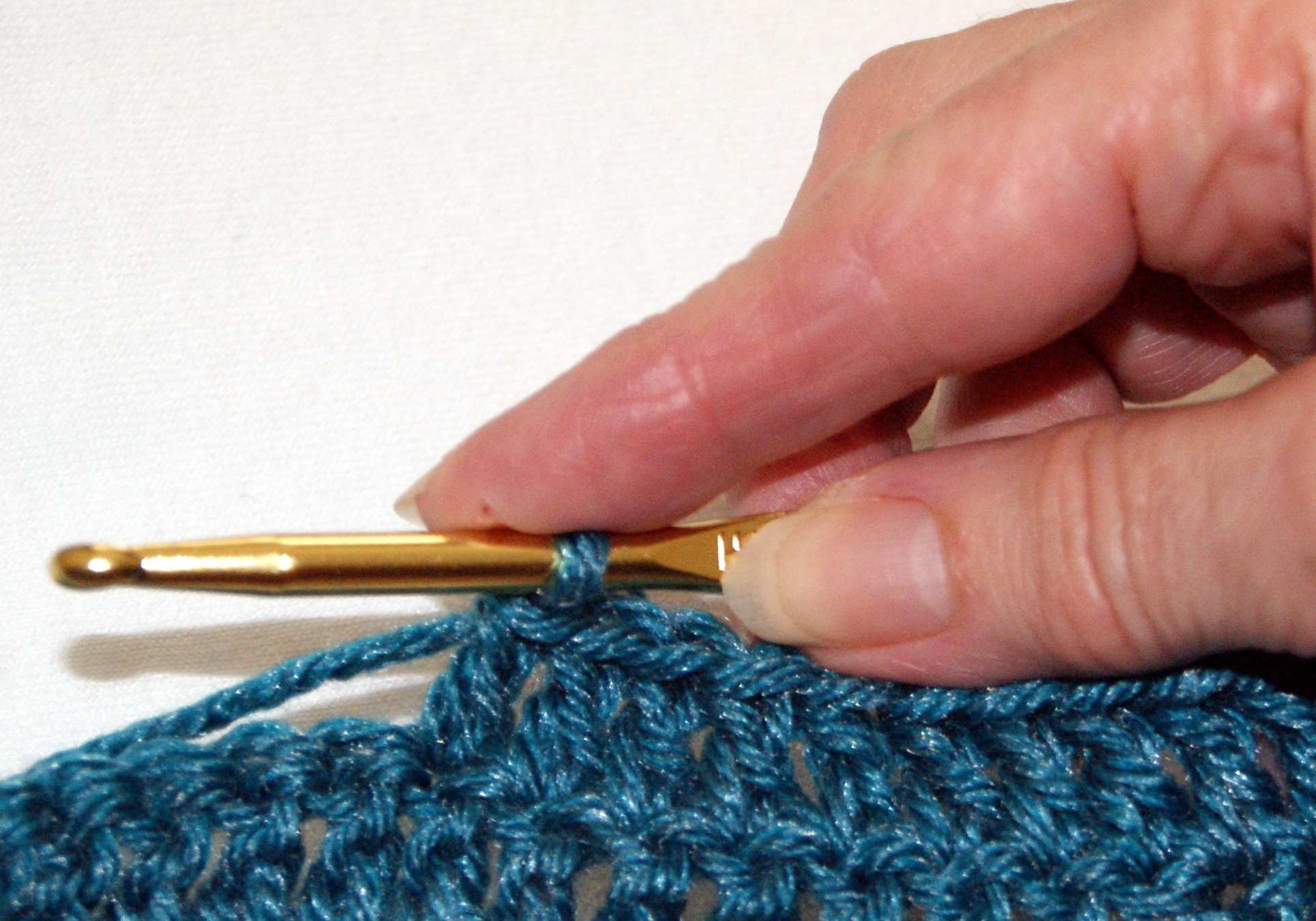
You will probably crochet using either a Pencil Grip or a Knife Grip.  I use the knife grip when I crochet and find it very comfortable and easy for me.  With my right hand, I place my thumb on the front of the thumb rest which will be facing me, place my index finger onto the shaft and hold the back of the thumb rest against my middle finger.  The handle will just lay against my ring finger and the palm.  There is very little movement of my fingers on my right hand when I crochet.  I slightly move my index finger along the shaft to help hold the loops in place as I make my stitches and that is it.

Knife grip using right hand

Now my left hand does a lot more work for me.  I personally like to wrap the yarn around several fingers to get good tension on the yarn.  I will place the yarn under my pinky finger, over my ring finger, under my middle finger and over my index finger.  My crochet piece will be held in place using my middle finger and thumb with my ring finger and pinky helping to hold ever so slightly.  My index finger on my left hand does all the work.  I yarn over onto the hook with my left index finger, push the point of the crochet hook through the proper loops using my right hand and bracing with my left middle finger, guiding with my left thumb, and using my left ring finger and pinky as support.  I have great success crocheting in this manner.   I don’t know if this is the motion a true right-handed crocheter uses but I have found this a very workable method for me and I am a very left-handed individual.   I even use my left foot to push the pedal on my sewing machine!!

Yarn weave through my left hand fingers


Doing a Stich


Keep practicing and work on what is really comfortable for you when crocheting.  Hopefully, this will give you some guidelines whether you are right or left-handed for holding your hook and work.  I know there are some good directions for left-handed crocheting if this method doesn’t work for you.  Give it a try, you might like it!!

  • TIP:  If you are really a beginner or if you are trying to teach a youngster how to crochet,  I would suggest that you only wrap the yarn over your left index finger as your tension guide until you get the feel of both hands and yarn working together.   After you feel comfortable with practice, then proceed to weave the yarn around the additional fingers on your left hand.

HAPPY CREATING!!

Disclaimer:  This post contains affiliate links – “small commission earned”
MATTRESS/WEAVING STITCH

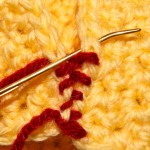
The MATTRESS STITCH or WEAVING STITCH is a very nice joining method especially for garments because it is virtually invisible.  When joining with this stitch, you  have your right sides facing you, side by side. Insert your needle through both loops on both pieces at the bottom edge, leaving about a 4″ tail, repeat again in the same stitch to help secure your thread.  Push your needle through both edge loops on the right side of the seam.  Pull the yarn through loosely.  Now insert the needle through both edge loops of the matching stitch on the left side.  Remember, to always keep your tapestry needle facing to the top of your piece and not to the side.  Continue alternating the joining stitches until you get to the end of your seam.  After completing about 3 stitches, pull your yarn snug and continue joining.

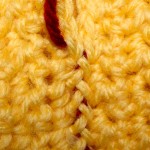
This stitch is a little harder to do with crochet stitches because you don’t have a cross-bar stitch like in knitting.  It is similar to doing a blind stitch in sewing.  As you can see from my pictures though, you form little “x’s” when you pull up your joining stitch snuggly and it is virtually invisible.  I used a very dark contrasting yarn for demonstration purposes but using your matching yarn, the joining seam will disappear.

Inserting needle from left to right under both loops on both sides


Pulling mattress stitch snuggly to join


Joining seams for your crochet projects is really a simple procedure.  Take your time and decide upon which joining method you prefer and will work the best for your finished piece.  Remember to weave in all your loose yarn tails too!

Spend some time with a youngster who might be interested in making crochet squares, and work together joining them into a cute baby doll blanket or a small coverlet to curl up with in the car or for reading books.  Who doesn’t like something handmade!!

HAPPY CREATING!!

Disclaimer:  This post contains affiliate links – “small commission earned”

Doing the BACK STITCH

Doing the BACK  STITCH is another method for joining seams as well as for adding decorative appliques or pockets to your crochet project.  This is also a great opportunity to use a contrasting color of yarn to make your applique or pocket designs really stand out.  

To do the Back Stitch for a seam, you will need to place your two pieces that need joining with the right sides together and hold it with one side (called the front) facing you and the other side (called the back) facing away from you.  Thread your yarning needle and pull the needle through both loops on both pieces leaving about a 4″ tail, I like to insert my needle again in that first stitch to help secure my thread.  Stitching from the front of your joining seam that would be facing you, insert your needle into the next stitch going through both loops on both pieces, pull snuggly. Skip the next stitch and insert from the back to the front through both loops on both pieces and pull your needle to the front.  Now, insert your needle from the front to the back through both loops on both pieces through the skipped stitch.  Continue this pattern until you have completed your joining seam.

Preparing your crochet project for a decorative applique or outer pocket remember to place your applique/pocket with the wrong side down onto the right side of your crochet project.   Figure out where you would like the applique/pocket to be placed or follow recommended directions from your pattern and pin your applique/pocket into place.  I use long-stemmed quilting pins with the round, glass ball ends (not with the flower end because the flower design will catch onto your yarn and maybe pull it).  Of course, if you have a very small item you are attaching to your piece, use smaller stemmed pins with the round ball tops.

Once you have your applique/pocket pinned to your project, you can begin doing the back stitch but this time you will need to insert from the back of your project leaving a 4″ tail, coming out the front of your applique/pocket.  Insert your needle from the front to the back in the very next stitch.  Now you will skip the next stitch, insert needle from the back to the front.  Now insert again from the front going through the stitch that you just skipped.  Continue with this process until you are done.  Don’t knot, leave a tail and weave both beginning tail and ending tail through your crochet stitches.

You can always attach your applique/pocket with a straight running stitch or whip stitch too.  It all depends upon the look you are achieving and how durable your item needs to be held in place.


*TIP:  Update an old sweater or hat with a funky crochet applique.  Teach a simple crochet motif to a youngster and let them update a piece of clothing or attach to a headband or barrette.  Adding your own personal touches to a store-bought item definitely makes it uniquely yours.

HAPPY CREATING!!!

Disclaimer:  This post contains affiliate links – “small commission earned”


WHIP STITCH

After completing your crochet piece, you have several options available as to how you want to join the seams of your project.  Probably the most common method of joining is the WHIP STITCH.   This joining method is not too bulky and creates a nice seam.

To begin, place your completed pieces right sides down and side by side.  Now you need to thread your tapestry/yarn needle.  I found this site that gives you a couple of different suggestions on how crafters thread a needle with yarn.  Myself, I fold my yarn in half and pinch that folded edge tight while holding the yarn very close to the edges of my index finger and thumb.  Now I  just slide or work the eye of the needle onto the yarn and pull through the edge of the loop.  You never knot the end of your yarn as you will just weave your tail through you stitches once you have completed your joining process.

Once your needle is threaded, leave about a 4″ tail for weaving and starting at one end, push the needle through both loops of your crochet stitches on both pieces that you are joining.  Some patterns might tell you to join by only going through one loop on each side of your seam.  Of course this is fine but take into consideration your finished project and if it needs to withstand heavy usage, I would recommend that you always insert through two loops on both pieces of your seam.  Pull the yarn snug but not too tight (you don’t want puckering) so that the two pieces fit closely against each other.  Draw your needle up and over and insert it into the next stitch. You will always be inserting your needle on the same side.  For example, if you begin joining by inserting your needle from the right side to the left (or vice versa) , that is how you would continue whip stitching until you reached the end of your seam.

*TIP:   Keep some practice swatches among your yarn stash so you can try out different joining stitches.  For a more dramatic look, you could use a contrasting color of yarn for your piece, just make sure your joining yarn is the same type and ply as your finished crochet project.

HAPPY CREATING!!

Disclaimer:  This post contains affiliate links – “small commission earned”